Loading...
Need Infectious Disease Disinfection help now?
HIGH RISK — Confirm provider credentials and availability for the specific case
HIGH RISK — Site-Specific Hazard Assessment Needed
Professional Infectious Disease Disinfection Services
Hospital-minded outbreak disinfection for facilities and homes: high-touch mapping, EPA-registered products, documented dwell times, and re-entry instructions—clean first, then disinfect.
Infectious disease disinfection provides targeted environmental disinfection after known or suspected pathogen exposure in commercial and residential settings, using EPA-registered products, correct dwell times, and application methods such as electrostatic spray or fogging after cleaning. It supports outbreak control; it does not replace medical care or public-health orders.
What is Infectious Disease Disinfection?
Infectious disease disinfection provides targeted environmental disinfection after known or suspected pathogen exposure in commercial and residential settings, using EPA-registered products, correct dwell times, and application methods such as electrostatic spray or fogging after cleaning. It supports outbreak control; it does not replace medical care or public-health orders.
A defensible infectious-disease scope maps relevant surfaces, removes gross soils, selects products whose labels support the organism and surface, documents contact time, and follows label re-entry instructions. Fogging does not replace cleaning where soil is present.
In practical terms, infectious disease disinfection is a documented hazard-control project: assess what is contaminated, prevent spread into clean rooms or shared building systems, remove or disinfect materials using methods matched to this niche, package regulated waste correctly when required, and verify completion with records a property owner, landlord, estate, or facility manager can keep. It is not a fragrance service, a same-day remodel guarantee, or a substitute for medical care, law enforcement, or public-health authority decisions.
Risk classification for this niche in our taxonomy: HIGH. That label describes typical hazard intensity for educational navigation—it is not a site-specific clearance certificate. Your written scope after assessment is the document that defines what will be done on your property.
In scope
- EPA-registered disinfectant application with dwell-time compliance
- Electrostatic spraying for uniform coverage where appropriate
- Protocol support for COVID-19, MRSA, C. diff, norovirus contexts
- ATP monitoring before/after on critical surfaces
- HEPA air purification support during service
- Compliance-oriented documentation for facilities
- Commercial and residential disinfection projects
- Outbreak response scheduling with area prioritization
- Product selection matched to listed organisms on the label
- Re-entry timing guidance based on product labels and ventilation
Out of scope / exclusions
- Medical treatment, testing, or vaccination
- Public health authority roles
- Replacement for hand hygiene and PPE programs
- Guarantees against future infection
- Daily janitorial staffing
- Occupied fogging without clearance protocols
When does infectious disease disinfection need a qualified provider?
A defensible infectious-disease scope maps relevant surfaces, removes gross soils, selects products whose labels support the organism and surface, documents contact time, and follows label re-entry instructions. Fogging does not replace cleaning where soil is present.
Training Matched to the Task
Ask which safety program applies to the scope: bloodborne-pathogen controls for covered exposure, HAZWOPER where hazardous-substance or emergency-response rules apply, and a compliant respiratory-protection program when respirators are required. Verify current records and insurance for the actual work.
Case-Specific Availability
For immediate danger, contact public emergency services first. For remediation, confirm the provider's current availability, credentials, scope, and arrival estimate for the actual address. HIGH risk situations should not be treated as DIY work.
Documented Completion
A closeout file can combine the scope, photos, products and label contact times, removal or waste records, and sampling results when the plan calls for them. ATP is only a relative residue indicator, not a stand-alone pathogen or clearance test.
Did You Know?
Training must match the task. Blood or other potentially infectious material can implicate OSHA's Bloodborne Pathogens standard; hazardous-substance or emergency-response work can implicate HAZWOPER. Ask which rule applies and request current records.
Quick Cost Estimator
126
Educational estimate only — not a quote
$6,800 - $11,050
Actual cost requires an on-site assessment. Insurance coverage varies by policy and cause of loss — we cannot promise approval.
When should you call a professional?
Confirmed outbreak in a facility
COVID-19, influenza, norovirus, MRSA, and similar outbreaks need EPA-registered disinfectants with correct dwell — not standard wipe-downs alone.
Healthcare or senior-care compliance documentation needs
Regulated facilities often require documented disinfection and verification for survey readiness.
High-touch surface load in shared spaces
Offices, gyms, schools, and retail spaces concentrate pathogens on shared touchpoints.
Post-illness environmental concern after a serious case
Soft goods and shared equipment may harbor pathogens after illness in the space.
Norovirus or GI outbreak with vomiting/diarrhea in common areas
Low infectious dose organisms demand meticulous pre-cleaning plus correct chemistry.
Spore-former concerns (e.g., C. difficile) in clinical contexts
Spore-forming bacteria require specific chemistries — not all hospital disinfectants are equivalent.
What hazards are specific to infectious disease disinfection?
Delaying professional infectious disease disinfection increases exposure for occupants and anyone who enters the space. This niche is classified high-risk — contamination can spread through materials and HVAC.
- Low infectious dose organisms (e.g., norovirus)
- Spore-forming bacteria requiring specific chemistries (e.g., C. diff)
- Cross-transmission via shared equipment and high-touch surfaces
- Chemical exposure if dwell products are misused or fogged into occupied rooms
- False security from fragrance or UV gimmicks without validated protocols
- Recontamination within hours in high-turnover facilities
- Soft-surface reservoirs (curtains, upholstery) missed by wipe-only programs
Educational summary — see OSHA 29 CFR 1910.1030, CDC environmental infection guidance, EPA disinfectant labels, and niche-specific state rules for authoritative requirements.
When should occupants leave the area?
Hot-zone guidance specific to infectious disease disinfection — not a substitute for emergency services.
- Evacuate rooms during fogging or electrostatic application when labels require vacated space
- Keep symptomatic people out of shared areas during active GI outbreaks when directed by public health
- Sensitive occupants should avoid freshly treated rooms until dry and ventilated
- Do not occupy spaces where incompatible chemicals were mixed or misapplied
Why is DIY infectious disease disinfection dangerous?
Household products and consumer PPE are not a substitute for trained remediation in this category. Improvised cleanup often spreads contamination, creates aerosols, destroys insurance documentation, and leaves reservoirs in porous materials that return as odor or exposure later.
- ✕Wrong product for the organism (not all disinfectants list every pathogen).
- ✕Wiping dry before dwell time ends wastes the application.
- ✕Fogging occupied rooms can harm people and pets.
- ✕Skipping pre-cleaning leaves organic soil that shields microbes.
- ✕DIY hospital grade claims on consumer bottles are often misunderstood.
- ✕Assuming trauma-scene cleanup chemistry is interchangeable with outbreak disinfection.
What not to do
- ✕Fogging dirty rooms without pre-cleaning
- ✕Using one product for every organism regardless of label
- ✕Skipping restrooms and break rooms during office outbreaks
- ✕Declaring the building safe forever after one treatment
- ✕Confusing odor masking with disinfection
Test Your Infectious Disease Disinfection Knowledge
Biohazard Knowledge Quiz
Q 1/5What determines a disinfectant contact time?
What does infectious disease disinfection include — and exclude?
We Provide
- EPA-registered disinfectant application with dwell-time compliance
- Electrostatic spraying for uniform coverage where appropriate
- Protocol support for COVID-19, MRSA, C. diff, norovirus contexts
- ATP monitoring before/after on critical surfaces
- HEPA air purification support during service
- Compliance-oriented documentation for facilities
- Commercial and residential disinfection projects
- Outbreak response scheduling with area prioritization
- Product selection matched to listed organisms on the label
- Re-entry timing guidance based on product labels and ventilation
You Should Know
- Medical treatment, testing, or vaccination
- Public health authority roles
- Replacement for hand hygiene and PPE programs
- Guarantees against future infection
- Daily janitorial staffing
- Occupied fogging without clearance protocols
Available Now — Do Not Wait
Need Infectious Disease Disinfection Right Now?
Delays can increase exposure and material damage. Call for a live dispatch ETA for your location.
How does the infectious disease disinfection process work?
A defensible infectious-disease scope maps relevant surfaces, removes gross soils, selects products whose labels support the organism and surface, documents contact time, and follows label re-entry instructions. Fogging does not replace cleaning where soil is present.
- 1
Define pathogen concerns and select products whose labels list those organisms.
Why it matters: Wrong product for the organism wastes the entire project.
- 2
Walk the facility to identify high-touch surfaces, restrooms, and outbreak epicenters.
Why it matters: Priority mapping prevents missing the surfaces that drive transmission.
- 3
Pre-clean visible soil — disinfectant does not work through heavy organic load.
Why it matters: Norovirus and similar organisms hide under soil films.
- 4
Apply product to achieve full wet dwell on target surfaces; time the contact period.
Why it matters: Wiping dry early is the most common disinfection failure mode.
- 5
Use electrostatic/fog methods only when appropriate for the chemistry and space.
Why it matters: Not every organism or building is a fogging problem — trauma scenes differ entirely.
- 6
Protect food-contact surfaces and sensitive electronics per label and facility rules.
Why it matters: Misapplication creates chemical exposure and equipment damage.
- 7
Verify high-touch surfaces with ATP or facility-required checks; re-clean failures.
Why it matters: Documentation beats assumptions after an outbreak complaint.
- 8
Log products, lot numbers, areas, and times for infection-control files.
Why it matters: Surveyors and risk managers ask for records, not marketing claims.
- 9
Advise re-entry timing based on product label and ventilation.
Why it matters: Premature re-entry can expose people to both pathogens and wet chemistry.
- 10
Recommend ongoing hand hygiene and cleaning program gaps as observations only.
Why it matters: One disinfection event does not replace daily infection-control practices.
Service Lines Within This Niche
COVID-19 & Coronavirus Disinfection
Environmental disinfection after COVID-19 concern: clean first, then EPA List N (or current equivalent) products with documented dwell times.
- 1Map occupied rooms and high-touch surfaces tied to the exposure concern
- 2Remove visible soil and trash that would block disinfectant contact
- 3Select EPA-registered products with emerging viral pathogen or List N claims as applicable
- 4Apply with verified wet contact time; use electrostatic methods only after cleaning when used
- 5Ventilate per label and provide written re-entry timing
- 6Log products, EPA numbers, and areas treated for facility records
Norovirus & Gastrointestinal Outbreak Response
Outbreak disinfection focused on vomit/fecal soils, high-touch surfaces, and soft goods decisions after GI illness clusters.
- 1Isolate affected rooms and pause shared food service if applicable
- 2Remove organic soils from vomit or fecal incidents before disinfection
- 3Use products effective against norovirus per label claims
- 4Expand cleaning to bathrooms, railings, and other high-touch pathways
- 5Recommend discard or commercial laundering of contaminated soft goods
- 6Document outbreak zones treated and reopening criteria for managers
MRSA & Healthcare-Associated Infection Control
Enhanced environmental cleaning support for MRSA and related HAI concerns in facilities—not a substitute for clinical infection control.
- 1Align scope with facility infection-prevention contacts when available
- 2Focus on high-touch surfaces and shared equipment exteriors
- 3Use EPA-registered products with appropriate organism claims and dwell times
- 4Avoid cross-contamination via tools and carts between clean and dirty zones
- 5Document methods for accreditation or internal audit files
- 6Clarify that medical isolation decisions remain with clinical staff
Facility-Wide Fogging Services
Electrostatic or fog application as a coverage aid after cleaning—not a standalone kill claim based on fog volume.
- 1Complete wipe cleaning of high-touch surfaces before fogging
- 2Protect food-contact surfaces and sensitive electronics per product rules
- 3Apply fog or electrostatic spray with documented product and dwell expectations
- 4Manage HVAC and vacancy during application
- 5Provide re-entry clocks based on label and ventilation
- 6Record treated square footage and product identifiers for risk managers
What standards should infectious disease disinfection follow?
1
High-touch mapping
Outbreak work targets transmission surfaces—not random fog volume through empty aisles.
2
Clean then disinfect
Visible soil removal is required before labeled dwell times can meet kill claims.
3
Product selection
Match EPA-registered products to the organism; List N claims apply when used for emerging viruses.
4
Re-entry clocks
Written vacancy and ventilation times protect staff and occupants after spray or fog.
5
Verification
ATP monitoring on critical high-touch surfaces before/after
6
Primary hazard
Low infectious dose organisms (e.g., norovirus)
What equipment is typical for infectious disease disinfection?
1
Electrostatic sprayers
Wrap complex geometries after pre-cleaning—coverage aid, not a substitute for wiping high-touch surfaces.
2
Thermal fogging equipment
Used in vacant/controlled spaces with documented products, dwell expectations, and re-entry clocks.
3
EPA List N / label-matched products
Disinfectants selected for the target organism with verified wet contact time after soil removal.
4
High-touch mapping tools
Room diagrams and surface lists so outbreak work hits transmission pathways, not random fog volume.
5
ATP (when biological soil is the concern)
Optional hard-surface checks after disinfection—does not clear chemical residues such as meth or CS.
6
PPE for disinfectant application
Gloves, eye protection, and respirators as required by product SDS during spray or fog work.
How is infectious disease disinfection verified?
- ATP monitoring on critical high-touch surfaces before/after
- Product label organism list matched to the outbreak concern
- Dwell-time and area treatment logs
- Facility infection-control checklist sign-off
- Re-entry clearance based on label dry times and ventilation
Process & Equipment Visuals
equipmentThermal Fogging

Thermal Fogging
Professional thermal fogging for infectious disease control
equipmentElectrostatic Coverage
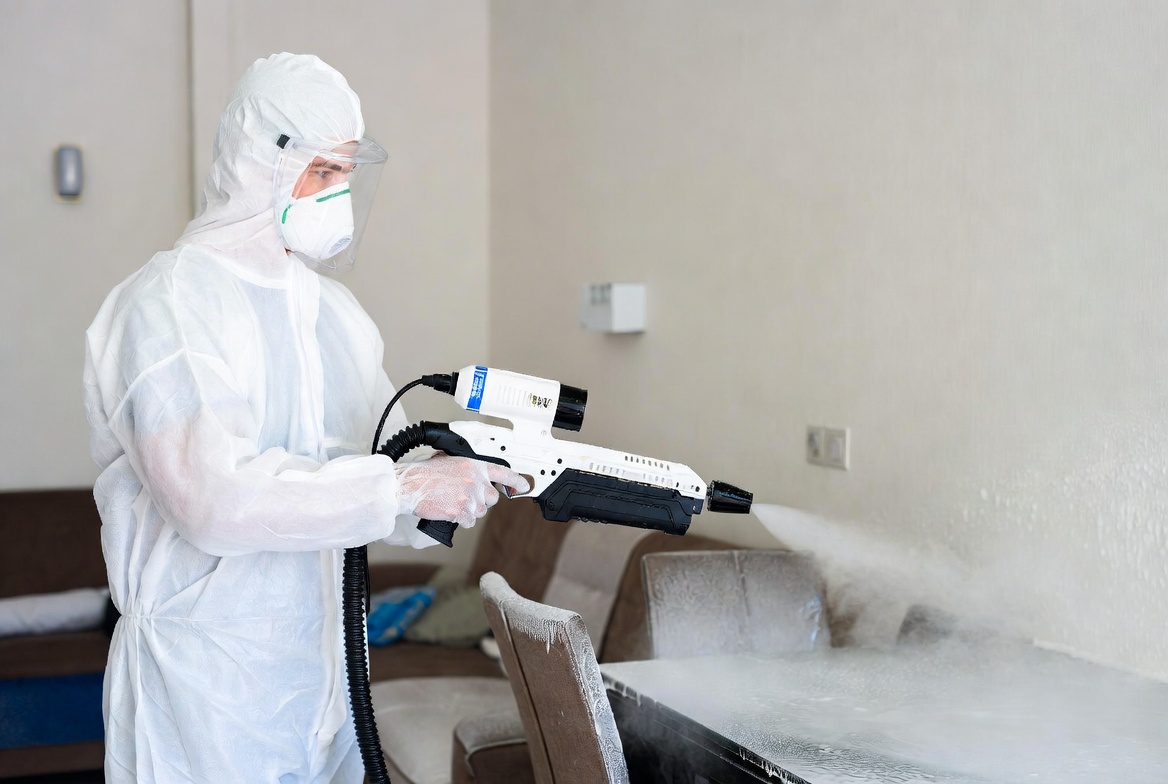
Electrostatic Coverage
Electrostatic spraying for infectious disease disinfection
educationDwell Time

Dwell Time
Dwell time monitoring for EPA-registered disinfection efficacy
trustDisinfection Certificate
Disinfection Certificate
Professional infectious disease disinfection certificate
Process Overview
A 30-second overview: high-touch mapping, clean first, EPA-registered products, dwell times, documented re-entry.
Transcript: A technician maps and treats high-touch surfaces in a clean-to-dirty sequence after pre-cleaning visible soil.
Community Polls — What Others Think About Infectious Disease Disinfection
If you discovered a infectious disease disinfection situation, what would you do first?
No visitor votes yet
What is the biggest fear people have about infectious disease disinfection?
No visitor votes yet
Does insurance cover infectious disease disinfection?
Coverage Reality Check
Coverage depends on your policy language and the cause of loss. We do not publish invented approval rates.
- Business interruption and contamination endorsements vary widely — review with a broker.
- Healthcare facilities often fund disinfection under infection-control budgets rather than property claims.
- Document outbreak dates and areas treated for liability files.
- Disinfection alone does not prove negligence claims either way — keep factual records.
- Do not expect property policies to pay routine outbreak disinfection automatically.
- Vendor certificates of insurance may be required for facility access.
$ What Affects Cost
- •Square footage & high-touch density: Mapped surfaces and rooms treated matter more than fog-machine hours alone.
- •Clean-then-disinfect labor: Soil removal before product application is a real line item—skipping it voids kill claims.
- •Product selection: Organism-specific or List N products, including sporicidal needs, change material cost.
- •Soft-goods decisions: Discard or commercial laundering of porous items expands outbreak scopes.
- •Repeat / surge visits: Cluster responses may need multiple passes over days—not a single fog event.
- •Documentation for facilities: EPA numbers, dwell logs, and re-entry clocks are often required by risk managers.
Get a Free Consultation
Tell us about your situation for coordinator follow-up. Provider availability and timing depend on the address, hazard, and case details.
Frequently asked questions about infectious disease disinfection
What is infectious disease disinfection as a facility service?▼
Infectious disease disinfection is targeted facility disinfection after known or suspected pathogen exposure—such as norovirus outbreaks, MRSA concerns, or respiratory disease clusters—using EPA-registered disinfectants, correct dwell times, and often electrostatic or fog application after cleaning. It supports environmental controls; it does not diagnose patients or issue quarantine orders. It is not a substitute for medical care, and it is not identical to routine janitorial contracts unless scoped that way. Outbreak response emphasizes high-touch mapping, PPE, and product selection matched to the organism. Clarify whether gross soil removal is included or whether the visit is disinfection-only after cleaning by others. For definition and scope conversations, put these boundaries in the written estimate so stakeholders are not surprised later: focus on high-touch mapping during outbreaks, require EPA List N product selection when applicable, and treat rebuild as a separate phase when materials leave the structure. In infectious disease disinfection projects specifically, ask the crew to explain how they will handle item 1 of this checklist in writing before mobilizing.
Should staff try to bleach everything themselves during an outbreak?▼
Untrained spraying can miss shadowed surfaces, use wrong dilutions, or skip dwell time—creating a false sense of safety. Norovirus, for example, is highly infectious at very low doses. Mixing chemicals can sicken staff. Professional protocols prioritize cleaning soil first, then disinfecting with verified product selection such as EPA List N references for emerging viral pathogen claims when applicable. Staff still play a role in isolating areas and pausing shared food service, but terminal disinfection of complex facilities benefits from trained application methods. Do not fog over visible vomit or feces and call it done. Escalate gross soil incidents to teams equipped for biohazard removal plus disinfection. For DIY decisions, the practical rule is isolation first—protect people from high-touch mapping during outbreaks, wait on EPA List N product selection when applicable, and do not improvise tools that worsen written re-entry clocks from labels. In infectious disease disinfection projects specifically, ask the crew to explain how they will handle item 2 of this checklist in writing before mobilizing.
Is there biohazard waste after infectious disease disinfection?▼
When gross soils, vomit, or blood are present, those materials may be regulated waste. Routine wipe debris from a clean surface disinfection may be ordinary trash depending on local rules. Outbreak responses that include gross soil removal should document the waste pathway and keep manifests when regulated waste is generated. Facilities should not place saturated biohazard materials in lobbies awaiting ordinary janitorial pickup. Ask how PPE and cleaning media are handled after enteric outbreaks. Waste discipline is part of infection control, not an afterthought to fogging. For waste handling, demand a pathway that matches high-touch mapping during outbreaks, keeps records suitable for written re-entry clocks from labels, and never substitutes municipal trash for materials tied to audit-ready product and dwell documentation. In infectious disease disinfection projects specifically, ask the crew to explain how they will handle item 3 of this checklist in writing before mobilizing. Keep a property file that includes photos, product names, and waste or clearance records unique to this infectious-disease-disinfection response so future buyers, tenants, or auditors can reconstruct what was done.
Does insurance or a landlord pay for outbreak disinfection?▼
Business interruption or pollution riders sometimes apply; many cases are an operating expense for the facility. Multifamily properties may split responsibility by lease language. Get a written scope before work so cost allocation between tenant and owner is clear. Schools and healthcare sites may have contractual or regulatory drivers independent of insurance. Insurers will want documentation of products, areas treated, and why the service was needed. Avoid vendors who sell guaranteed claim payment as a marketing hook for outbreak work. For insurance and payment, document written re-entry clocks from labels with photos and scopes, ask the carrier about EPA List N product selection when applicable, and reject vendors who invent approval rates instead of explaining high-touch mapping during outbreaks. In infectious disease disinfection projects specifically, ask the crew to explain how they will handle item 4 of this checklist in writing before mobilizing. Keep a property file that includes photos, product names, and waste or clearance records unique to this infectious-disease-disinfection response so future buyers, tenants, or auditors can reconstruct what was done.
What process distinguishes cleaning, sanitizing, and disinfecting during a response?▼
Cleaning removes soil; sanitizing reduces microbes to levels considered safe for public health on some surfaces; disinfecting kills a defined set of pathogens per product claims when used correctly. Outbreak response requires cleaning and disinfection—not fragrance mopping. Electrostatic spraying and fogging are application methods, not magic that skips soil removal. High-touch mapping, dwell-time monitoring, and HVAC or occupancy controls during application complete the process. Documentation should list EPA registration numbers and areas treated. Process clarity prevents arguments about whether a perfume fog met a disinfection standard. For process quality, sequence work around EPA List N product selection when applicable, control high-touch mapping during outbreaks, and finish with documentation that reflects audit-ready product and dwell documentation rather than a verbal “all set.” In infectious disease disinfection projects specifically, ask the crew to explain how they will handle item 5 of this checklist in writing before mobilizing. Keep a property file that includes photos, product names, and waste or clearance records unique to this infectious-disease-disinfection response so future buyers, tenants, or auditors can reconstruct what was done.
How do facilities prove disinfection work was done properly?▼
Documentation should list products, EPA registration numbers, areas treated, dwell times, and optional ATP results on critical surfaces. Certification letters without those details have limited value for regulators or risk managers. Some healthcare settings define additional acceptance criteria in their infection-prevention plans. Photographic evidence of preparation and sealed areas can help. If fogging was used, include re-entry times from the label. Proof is a packet a risk manager can audit, not a logo on a door hanger. For verification, define acceptance using audit-ready product and dwell documentation, retain proof related to written re-entry clocks from labels, and do not reopen based on appearance alone when high-touch mapping during outbreaks remains plausible. In infectious disease disinfection projects specifically, ask the crew to explain how they will handle item 6 of this checklist in writing before mobilizing. Keep a property file that includes photos, product names, and waste or clearance records unique to this infectious-disease-disinfection response so future buyers, tenants, or auditors can reconstruct what was done.
How soon can occupants return after fogging or spray disinfection?▼
Re-entry depends on the product label and application method—often a few hours after dwell and ventilation, sometimes longer for dense fog. Demand written re-entry instructions rather than assuming dry means safe. Sensitive occupants may need additional buffer time. Coordinate reopen with operations so food areas, clinics, or classrooms do not restart mid-dwell. If lingering chemical odor is strong, ventilate further and consult the SDS. Timeline honesty prevents staff from walking into active applications. For timeline planning, build milestones around EPA List N product selection when applicable, contingency for written re-entry clocks from labels, and honest drivers such as high-touch mapping during outbreaks instead of brochure averages. In infectious disease disinfection projects specifically, ask the crew to explain how they will handle item 7 of this checklist in writing before mobilizing. Keep a property file that includes photos, product names, and waste or clearance records unique to this infectious-disease-disinfection response so future buyers, tenants, or auditors can reconstruct what was done.
When do odors after disinfection indicate a problem?▼
Strong chemical odor may mean poor ventilation after application or over-application; biological odor that returns later may mean missed soil in carpets or restrooms. Distinguish disinfectant smell from sewage or vomit reservoirs that were never removed. Fragrance additives are not evidence of efficacy. If employees report irritation, review product choice, dilution, and air exchange. If gastrointestinal illness continues, revisit high-touch and restroom protocols rather than only buying more perfume fog. Odor is operational feedback, not a vanity metric. For odor and air quality, tie treatments to audit-ready product and dwell documentation, replace media when high-touch mapping during outbreaks recirculates, and remember fragrance cannot replace EPA List N product selection when applicable. In infectious disease disinfection projects specifically, ask the crew to explain how they will handle item 8 of this checklist in writing before mobilizing. Keep a property file that includes photos, product names, and waste or clearance records unique to this infectious-disease-disinfection response so future buyers, tenants, or auditors can reconstruct what was done.
How should multi-tenant offices and HOAs coordinate outbreak disinfection?▼
Shared restrooms, elevators, and amenities are high-value targets in a scope. Managers should sequence work to protect open tenants, post factual notices, and avoid stigmatizing individuals. Cost sharing follows leases and whether the event is building-wide or unit-specific. Do not rely solely on day porters for norovirus terminal cleans in shared facilities. Professional disinfection with documented dwell times complements, rather than replaces, hand hygiene and exclusion policies. Coordination with employers about reopen timing reduces ping-pong contamination between home and office. For multi-unit and HOA coordination, assign authority for written re-entry clocks from labels, protect shared pathways from high-touch mapping during outbreaks, and communicate schedules without graphic detail while addressing EPA List N product selection when applicable. In infectious disease disinfection projects specifically, ask the crew to explain how they will handle item 9 of this checklist in writing before mobilizing. Keep a property file that includes photos, product names, and waste or clearance records unique to this infectious-disease-disinfection response so future buyers, tenants, or auditors can reconstruct what was done.
What extra steps protect children, patients, and immunocompromised populations during outbreak work?▼
Pediatric, elder-care, and immunocompromised settings should emphasize sporicidal needs when C. difficile is a concern, meticulous restroom work for enteric outbreaks, and conservative reopen criteria. Clinical isolation decisions remain with medical and public-health authorities. Remove or carefully handle soft toys and porous therapy items that cannot be reliably disinfected. Schedule applications when vulnerable occupants can be elsewhere. Special populations justify more documentation, more high-touch attention, and less tolerance for skipped dwell times. For children, elders, and other vulnerable occupants, relocate during high-touch mapping during outbreaks, delay return until EPA List N product selection when applicable, and bias toward replacement when audit-ready product and dwell documentation cannot be verified on items they touch. In infectious disease disinfection projects specifically, ask the crew to explain how they will handle item 10 of this checklist in writing before mobilizing. Keep a property file that includes photos, product names, and waste or clearance records unique to this infectious-disease-disinfection response so future buyers, tenants, or auditors can reconstruct what was done.
How do you choose a infectious disease disinfection provider?
EPA-registered product list matched to target organisms (e.g. List N claims)
Clean-then-disinfect sequencing in every written ticket
Documented dwell times and re-entry clocks
High-touch mapping for outbreak responses
SDS-aware PPE for spray/fog application
Facility documentation packet (areas treated, products, timestamps)
Contact line available — provider timing is case-specific
Need Emergency Infectious Disease Disinfection?
Call for situation-specific planning questions. Confirm provider availability and timing for the actual address.
Call Now: 1-877-246-2532