Short answer
Enzyme detergents loosen proteins, fats, and slimy buildup so a registered disinfectant can reach the germs underneath. That makes them useful in the cleaning step. Probiotic cleaners are a newer idea with limited proof, and they are not registered as disinfectants. After an illness, neither one replaces a disinfectant whose label lists your germ, used on a clean surface for the full wet time.
Why are biological cleaners coming up when people talk about disinfection?
Regular disinfection relies on chemicals that damage germs directly. In the past few years, interest has grown in biological products. Some break down the material that germs hide in. Others try to crowd out harmful germs with harmless ones. You will see both ideas in product ads, sometimes with bold claims.
Some of this interest is well earned. Hospitals have used enzyme detergents for years to clean surgical tools before they are sterilized. Enzymes are good at dissolving dried blood and tissue. Other ideas, such as spraying helpful bacteria on hospital surfaces, are still being studied.
If you are dealing with an illness at home or in a facility, the key is to know which job each product can do. Cleaning, disinfecting, and odor control are different jobs. Biological products fit only some of them.
How enzyme detergents help disinfection
Enzyme detergents contain proteins that break down certain kinds of grime from living things. Proteases work on the proteins in blood, mucus, and vomit. Lipases break down oils and fats. Amylases handle starches. Once that grime is dissolved, it is easier to remove from a surface.
That matters because grime protects germs. It can shield them from a disinfectant. With some chemicals, like chlorine, it can also use up the active ingredient before it reaches the germs. A surface cleaned well with an enzyme detergent gives your disinfectant a better chance to work as its label describes.
Enzyme detergents are most useful on items with cracks and grooves. Think of reusable medical devices, commode frames, and textured grab bars. Dried residue on these is hard to scrub out by hand.
Enzymes do have limits. They slow down in cold water. They can lose strength if stored too long or in heat. They also need time on the grime to work, so a quick spray and wipe gives them little chance. Follow the label for how to mix the product, what water temperature to use, and how long to leave it on. Replace bottles that are past their date.
- Use enzymes in the cleaning step, before you disinfect.
- Rinse or wipe away enzyme residue if the disinfectant label calls for a clean surface.
- Follow the enzyme product's directions on soak time and temperature.
- Then apply a registered disinfectant whose label lists the germ, for the full wet time.
Enzymes and biofilms
A biofilm is a layer of germs held in a sticky slime they make themselves. Biofilms form in drains, sink traps, and damp equipment. Dry biofilms can also form on surfaces that are touched often in healthcare settings. Germs inside a biofilm stand up to disinfectants better than germs floating free.
Many health workers still overlook dry biofilms. Centeleghe and colleagues reported in 2024 that while 87.6% of surveyed healthcare professionals had heard of biofilms, only 39.1% knew of dry-surface biofilms. That gap helps explain why some surfaces seem to get dirty again soon after cleaning.
Enzymes that break down the proteins and sugars in biofilm can help loosen it, mostly in drains and on equipment. Scrubbing with a brush or microfiber cloth is still the most reliable way to break up biofilm on surfaces. Enzymes and scrubbing together get the surface ready. Disinfection comes next.
Probiotic cleaners and the registration question
Probiotic cleaners, also called microbial cleaners, contain harmless bacteria. These are often Bacillus species in spore form. The idea is that these bacteria settle on surfaces and beat harmful germs to the space and food. Over time, that is meant to lower the harmful germs' numbers.
Some hospital studies have tried this approach, with interesting early results. But the proof is still growing. Results vary by product, by setting, and by how the results were measured. These products are not registered with EPA as disinfectants. Their labels do not list specific disease germs.
If your household is dealing with norovirus, or your facility is managing C. difficile, a probiotic cleaner does not replace a disinfectant. Using a disinfectant after a probiotic product will also kill the helpful bacteria. So the two approaches do not stack neatly. If a company offers probiotic cleaning for an outbreak, ask what independent proof supports that use.
There is also a practical concern for people in fragile health. The bacteria in these products are chosen to be low risk. Even so, facilities that care for people with weak immune systems, such as transplant or cancer units, may restrict them. At home, if someone has a very weak immune system, ask their care team before you bring in any product with live bacteria.
In the United States, a product that claims to kill or control germs on surfaces is regulated as a pesticide. It must be registered with EPA before it can be sold as a disinfectant.
Registration means the maker sent in data. The data must show the product works against the germs listed on its label, under the conditions described. Enzyme detergents and probiotic cleaners are usually sold as cleaners, not disinfectants. So they generally do not go through that process for germ-killing claims.
That does not make them useless. It means you should judge them as cleaners. Sometimes the ads for a biological product hint that it controls disease, but the label has no registration number and no list of germs. Treat that claim with caution.
After someone vomits: the order of steps, and odors
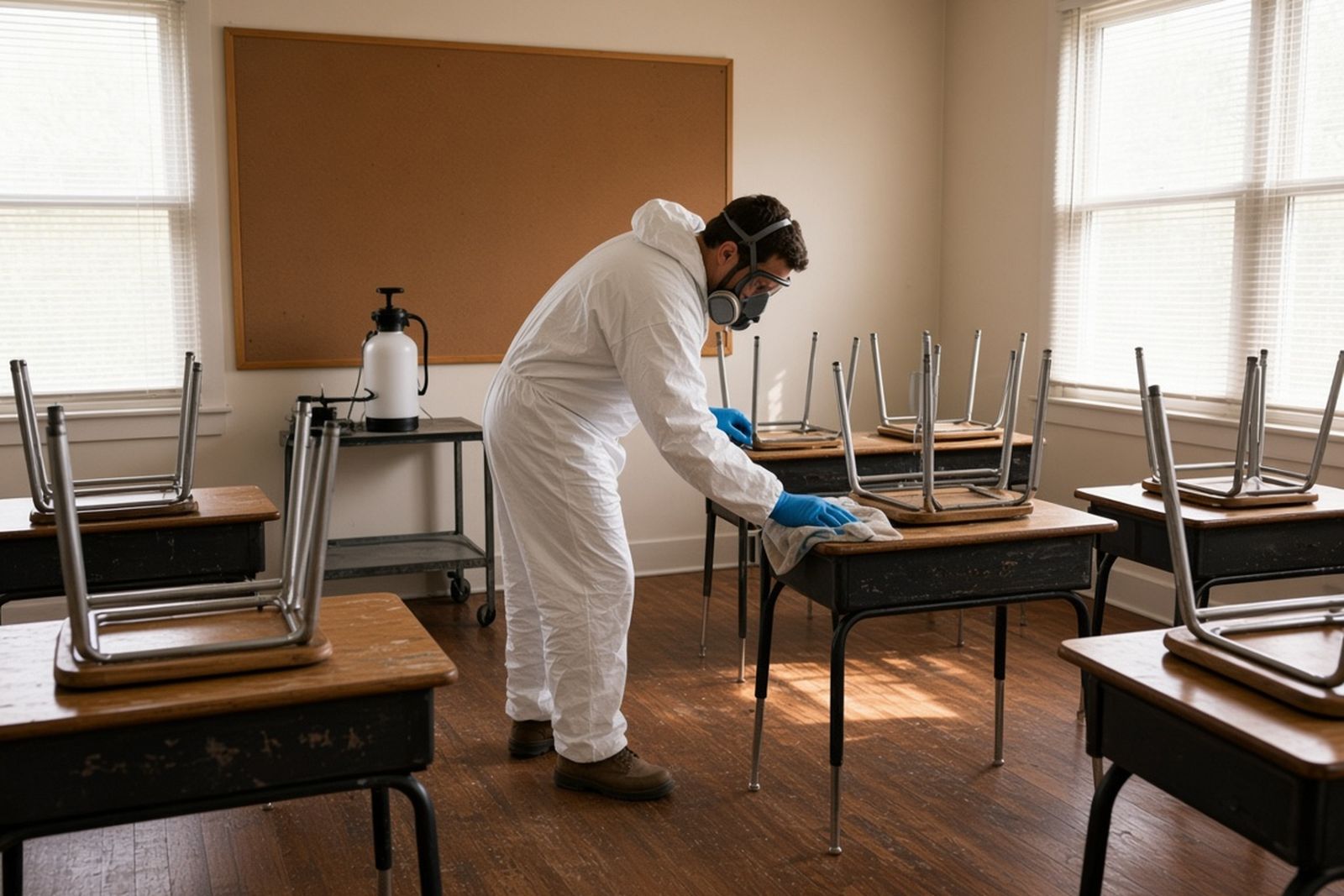
Vomit on a textured cafeteria bench or a classroom floor shows how the pieces fit. The person cleaning up uses a body fluid spill kit. It holds absorbent powder, disposable scoops, gloves, and an enzyme cleaner. First they remove the bulk of the mess. Next the enzyme cleaner goes on to break down residue in textured surfaces and along floor seams, and the area is wiped and rinsed. Norovirus is a common cause of sudden vomiting. So a disinfectant whose label lists norovirus goes on last and stays wet for the full time on the label.
The enzyme cleaner makes the surface clean enough for the disinfectant to work. By itself, it would not deal with the risk of a stomach bug spreading to the next person who sits there. Stock every spill kit with both products. Label each one clearly for the step it is used in. Train your substitute and part-time staff on the order too. An emergency cleanup is not the time to read two labels for the first time.
Illnesses with vomiting or diarrhea can leave odors in carpets, mattresses, and upholstery. Enzyme and microbial products are well suited to breaking down the residue that causes those smells. They are most helpful in soft materials that harsh chemicals would damage.
The same order applies. Remove what you can, then clean. Disinfect where the material allows it. Then use an enzyme product for any odor that is left. For a heavily soiled mattress or sofa, replacing it is sometimes the more practical and reassuring choice.
Laundry is another place enzymes help. Many laundry detergents already contain enzymes that lift proteins from bedding and towels. Wash soiled linens promptly on the warmest setting the fabric allows, and run a full drying cycle. That handles most household needs after a stomach illness. Wear gloves when you handle heavily soiled items. Do not shake them out, since that can spread particles.
What should you ask a company about biological products?
Does the company you may hire plan to use enzyme or microbial products? A few questions will show you how they fit the plan. Do you run a school, childcare center, or care facility? Then also ask your licensing agency whether any product rules apply.
- Is this product used for cleaning, odor control, or disinfection?
- Does it have an EPA registration number, and which germs are listed?
- Which disinfectant will you use for the germ that caused the illness, and when?
- How will you keep the biological step and the disinfecting step from working against each other?
- What proof supports this product in places like mine?
The practical takeaway
Think of biological products as helpers in the cleaning step. Enzyme detergents can make surfaces cleaner, loosen biofilm, and reduce odor. That in turn helps your disinfectant work better. Probiotic cleaners are still being studied, with limited proof for outbreak control.
After an illness, the core of the job does not change. Clean the surface. Choose a registered disinfectant whose label lists the germ. Keep it wet for the full contact time. Focus on the surfaces people touch. Biological products can support that plan, but they cannot stand in for it.
When you read a label or a proposal, look for plain words about what the product does and does not do. Honest descriptions tend to come from companies that know the difference between making a surface clean and making it safer.
If you manage a facility, write this difference into your cleaning procedures. Label spray bottles clearly as cleaner or disinfectant, and train your staff to use them in the right order. Mix-ups between look-alike bottles are a common reason disinfection fails, and you can avoid them.