Free sanitization & fogging tool
Sanitization & Fogging DIY or Call a Pro? Risk Check
Eight yes-or-no questions that produce a risk level and explain when professional help is the safer choice.
Many buildings can meet their disinfecting needs with a well-run wipe-and-wait program done by their own staff. Some are tempted to buy a fogger and go further. The DIY or Call a Pro Risk Check asks eight yes-or-no questions. They separate sensible in-house work from the rest. Is there visible dirt, body fluid, sewage, or mold that has not been removed? Would the method need the space empty for longer than you can manage? Does the space share an air system with areas in use? Are there electronics, food surfaces, or delicate stock? Is a confirmed outbreak or a health agency involved? Do you have a product whose label allows the method you plan to use? Is anyone planning to use ozone? Is this a bus, a childcare room, or another setting with special rules?
The result is a risk level with an explanation of which answers drove it. The tool does not push everyone toward hiring a company. Picture a small office that can wipe door handles, desks, and restroom fixtures with a registered product. It lets the product sit for the time on the label. That office is doing exactly what disinfecting requires, and no fogger improves on that. The risk goes up when someone wants to fog around people or when dirt is present. It also goes up when the label does not allow the method, or when the air system cannot be closed off. The explanation also describes what a pro brings. That includes controlled dilution, following the label, and coordinating the air system. It also includes checking that surfaces stay wet long enough, and a service record that holds up to review.
How to use it
- 1Answer the eight questions based on what you know about the space, the product, and the people in it.
- 2Read the risk level and the explanation of which factors moved it up or down.
- 3If the result points to a pro, use the vetting checklist and cost estimator to prepare for that talk.
- 4If the result supports doing it in house, follow the label exactly. Stop if the situation changes.
Prefer to ask a person?
Your request is sent to the follow-up inbox. A coordinator can reply by email. Not for emergencies; call 911 first if anyone is in danger.
Check whether DIY is safe
Sanitization & Fogging: DIY or call a pro?
Eight yes-or-no questions. The result is an educational risk level, not a safety clearance.
1. Is there blood, body fluid, or anything that could carry a bloodborne pathogen?
2. Has the material soaked into carpet, padding, a mattress, drywall or a subfloor?
3. Is there a strong or lingering odor?
4. Could needles, broken glass, drug residue or unknown chemicals be present?
5. Does the affected area cover more than a small spot, or more than one room?
6. Will children, older adults, pregnant people or anyone immunocompromised use the space afterward?
7. Do you need documentation for insurance, a landlord, a sale, or an estate?
8. Would you be doing this while grieving, exhausted or under time pressure?
8 questions left to answer.
A worked example
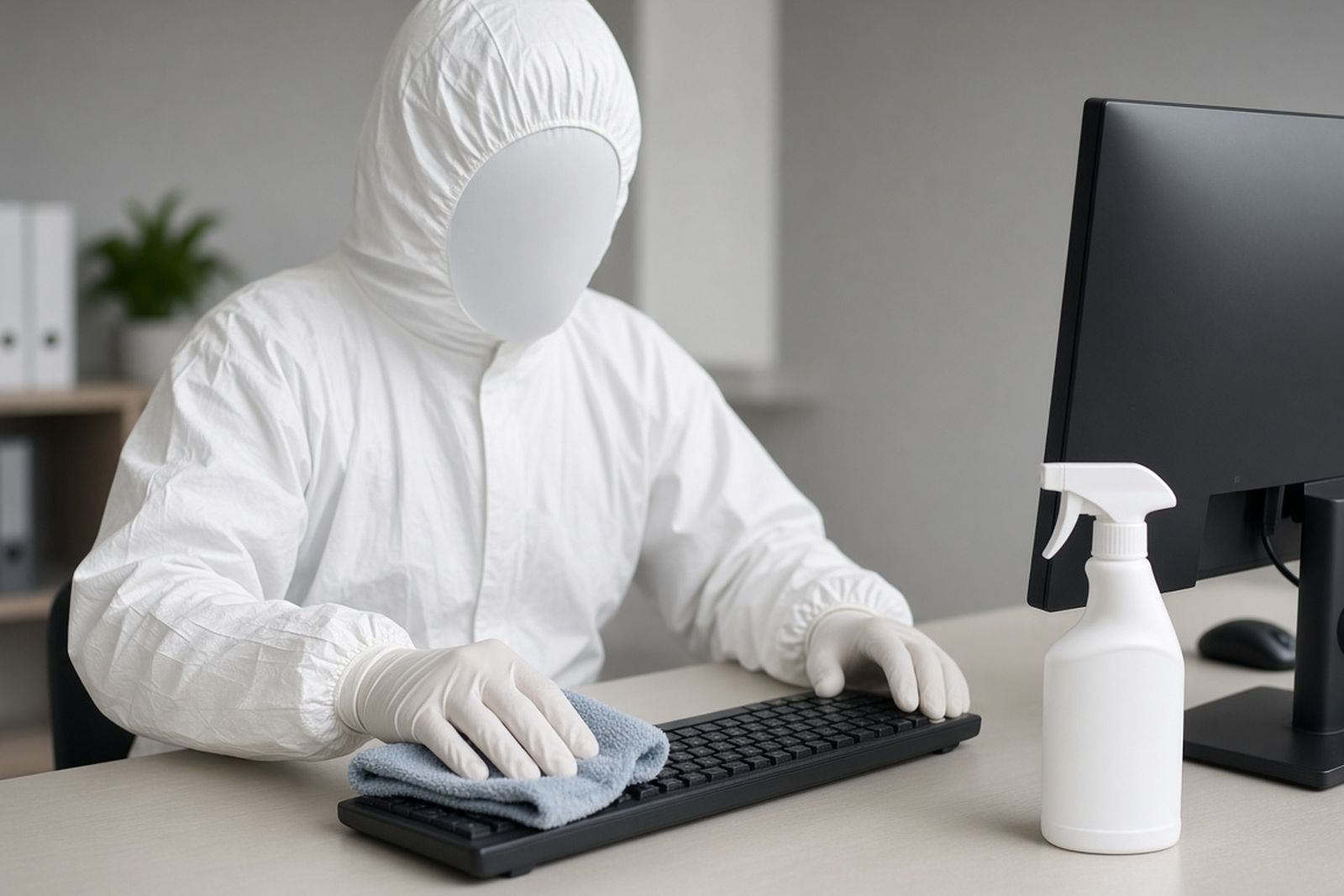
Picture a made-up dental office manager. A staff member has tested positive for a lung illness. She wants to wipe down the front desk area, the restroom, and the shared break room with a registered disinfectant. She will keep surfaces wet for the time on the label. She answers the risk check. There is no visible dirt or fluid. No long empty time is needed, because wiping does not require it. The air system is shared, but wiping does not put product into the air. Electronics are present, but wipes can be used with care. No health agency is involved. Her product's label allows wiping. There is no ozone, and it is not a special setting. The tool gives a lower risk level. It explains that wiping and waiting with a labeled product is the standard method and that her plan fits. It reminds her about gloves, fresh air, and wet time. Now picture a made-up gym owner who bought a fogger online. He plans to run it across the training floor tonight while the cleaning crew finishes mopping. His product's label only mentions spraying. His answers put dirt present, people present, label mismatch, and a shared air system in the yes column. The tool gives a high risk level. It explains that each of those factors alone makes the plan unsafe and likely useless. It says a company or a redesigned wiping program is the better route.
Facts worth knowing
NIOSH says airborne disinfectants can cause serious asthma even at levels below the legal workplace limits.
Why it matters: If you have asthma or breathing problems, ask what chemical will be used and how long you should stay out afterward.
The CDC says washing hands with soap cuts the number of people who get sick with diarrhea by 23% to 40%.
Why it matters: Wash your hands with soap after any cleanup or contact with a contaminated area.
In a 2026 lab study, electrostatic spraying of 2% hydrogen peroxide left wet for 10 minutes cut E. coli on 16 surface types by more than a million-fold.
Why it matters: Ask how long the product will stay wet on your surfaces, since the result depended on the full contact time.
DIY or Call a Pro? Risk Check questions for sanitization & fogging
Why does a label mismatch push the result so hard?
Because the label is the legal and scientific basis for the product's claims under FIFRA, the federal pesticide law. A product tested and registered for wiping has not been shown to work when fogged. Droplet size, wet time, and the risk of breathing it in all change. Using it outside its label may break the rules. It also gives you no proof the treatment did anything. That is why the tool treats it as a deciding factor.
Can staff do the cleaning and a company do the application?
That split is common and often makes sense. Cleaning staff remove dirt and wipe the surfaces people touch most. Then a company sprays an electrostatic or fog treatment on hard-to-reach areas, with the space empty and the air system closed off. The tool's explanation can help you decide which parts fit your staff's training. It also shows which parts need gear and label know-how you do not have.
Does a low risk result mean the space is disinfected?
It means the plan you described seems fitting and manageable. It does not prove that anyone followed the label, kept surfaces wet long enough, or reached every surface. Things can change. You might find vomit in a restroom, or learn that a health agency is involved. If so, run the check again with the new facts before you go on.
How does the tool treat buses and childcare rooms?
As settings with special limits. Buses have dashboard electronics, fabric seats, and short turnarounds. Childcare rooms have surfaces that go into children's mouths. They also often have stricter rules on who can be present and which products can be used. Both push the result toward getting a pro's input, or toward a carefully planned wiping routine instead of fogging. Both also bring a reminder to check local rules.
What does the tool assume for an in-house result?
It assumes several things. You have a registered product whose label allows the method you plan to use, and you dilute it correctly. You wear gloves and eye protection, and the space has good airflow. You can keep surfaces wet for the full time on the label. And no one else is nearby during spraying or wiping. If any of those is missing, the risk level goes up. It never treats a home fogger, an essential-oil mist, or an ozone machine as an OK substitute.
We learned the room shares ventilation with other offices. Should I redo the check?
Yes. The result depends on your answers. So a new fact can change the risk level for a fogging job. Examples are a shared air system, dirt found under a rug, or new advice from the health department. Redo the check whenever conditions change, or before you treat a different space. Comparing the old and new results shows which factor made the difference.
Can I use the result to explain a decision to leadership?
It can help. The explanation lists which answers drove the risk level. That gives you a clear, plain-language reason for doing the work in house or bringing in a company. Pair it with the product label and a short description of the space. Leaders tend to accept a choice more easily when the reasoning is written down, rather than based on a general feeling.
Related community polls
Vote to see how other people answered. You can change your answer at any time.
A vendor offers to fog your classrooms at lunch while students are outside. What do you say?
How do you see repeat fogging contracts today?
Other sanitization & fogging tools
Cost Range Estimator
Set the affected area, surface types, severity and extras to see a rough cost range and what pushes it up or down.
OpenCompany Vetting Checklist
Fifteen questions to ask any cleanup company, a score that shows how ready you are to hire, and a list of what is still unanswered.
OpenInsurance Claim Organizer
A guided checklist from finding the policy to tracking the insurer’s decision, with a printable summary of where the claim stands.
OpenFirst 24 Hours Planner
Tell the planner a few facts about the situation and get an ordered list of who to call, what not to touch, and what to photograph.
OpenWaste & Disposal Classifier
Five questions about the material point to the likely waste category and which authority to confirm the rules with.
OpenMore on sanitization & fogging
Sanitization & Fogging services
See how electrostatic spray, heat fogging, UV-C, and scheduled programs fit into a clean-first, then-disinfect plan for your building or fleet.
Costs explained
What drives the price, published cost ranges, and how to read a written quote line by line.

Insurance and payment
Which policies may respond, how to document a claim, and what to do if coverage is denied.
Community polls
See how other facility managers weigh fogging contracts, air system control, label checks, and re-entry timing against cost and daily disruption.
Knowledge quiz
Check whether you can spot a label mismatch, fogging with people present, or a skipped cleaning step. Then review the study guide.
Articles and resources
Read explainers on spray methods, product labels, re-entry timing, ozone risks, and why routine wiping still matters in every building.