Short answer
Judge any medical waste tool by four things. Does it give you records your state accepts? Can you get to your own data when you need it? Does it cut handling errors or exposure? Does it hold up when something fails? Container barcodes, electronic tracking, GPS, and portals can help. On-site treatment devices may need state approval. No tool replaces registration, trained people, proper packing, and a paper trail.
Why think critically about waste transport technology
More and more, medical waste haulers point to software, sensors, and equipment as reasons to choose them. Some of these tools really do improve safety and record-keeping. Others mostly improve the sales pitch. You are the one who answers to inspectors. So you need to know which is which.
The rules make this harder. Medical waste is regulated mainly by state environmental and health departments. There is no single national standard for what a tracking system must record. Your state's rules are your yardstick.
These questions apply whether you run one dental office or a regional chain of clinics. Start with what your rules require. Then ask whether a tool helps you meet those rules more reliably.
One useful habit is to ask every vendor the same first question. What problem does this tool solve for me, the customer? The answer may be mostly about the hauler's own efficiency. The tool may still be worth having. But you should not pay extra for it or accept weaker records because of it. If the answer is fewer errors, faster records, or safer handling at your site, you have something real to test.
Six kinds of tools haulers use now
Most tools fall into a few groups. Tracking tools follow containers and records. Fleet tools manage trucks and routes. Handling tools change how containers are filled, moved, and cleaned. Treatment tools change what happens to the waste itself. Some of those are small devices placed at your site.
Each group has different benefits and different risks. A customer portal that shows your pickup history is low risk and easy to test. An on-site treatment unit that changes how your waste is regulated has higher stakes. It may need approval before you use it.
Once you know which group a product belongs in, you know how closely to look at it.
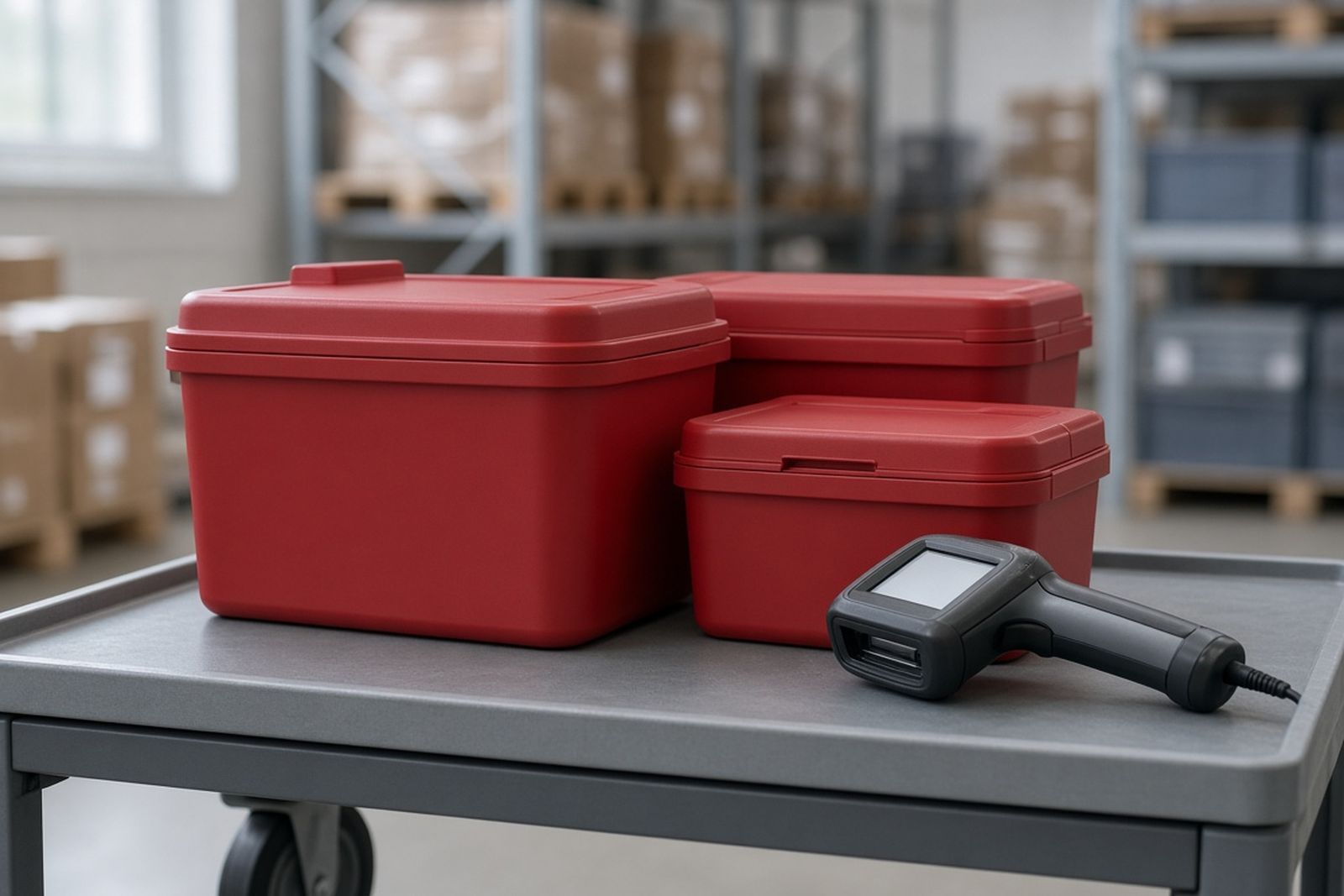
- Barcodes or RFID tags (small radio tags) on containers, scanned at pickup and at treatment
- Electronic shipping papers, waste shipping records, and signatures captured on a screen
- Customer portals with pickup history, certificates, and invoices
- GPS and other truck sensors that track routes and temperature
- Machines that wash reusable carts and tubs
- On-site treatment devices, such as small autoclaves (steam units) or sharps processors
Electronic tracking, barcodes, and RFID
Some states accept electronic tracking records in place of paper forms. Others still require specific paper forms, signed copies, or state-issued forms. A hauler's app may produce excellent records that still do not meet a certain state rule on their own.
Before you rely on electronic records, ask the hauler which papers it provides for your state. Ask whether your state agency has accepted them. If you are unsure, ask the agency directly. Keep in mind that an inspector may ask you, not the hauler, to show the records.
Also ask how long your records stay available and whether you can export them in a common format. Ask what happens to your records if you change haulers or the company is bought. A portal you cannot get into next year is not a records system.
Scanning each container at pickup, at transfer, and at treatment creates a detailed chain of custody. That is the record of who held your waste at each step. If a container goes missing, the scan history shows where it was last seen. If a container is damaged, the scan can link the damage to a specific pickup. If you are a large customer, container-level data also helps with waste audits and with splitting costs by department.
The limits are practical. Scans only work if drivers and plant workers really scan every container. Labels must survive moisture and handling. The system must check that the counts match. A scan proves a container passed a reader. It does not prove what was inside or that the waste was packed properly.
Ask for a sample chain-of-custody report so you can see what data you would really get.
Are GPS and temperature monitoring worth asking about?
Truck tracking can show when a truck reached your site, how long it stayed, and whether it followed its expected route. That helps settle billing disputes and missed pickups. For large haulers, it helps plan efficient routes.
Temperature tracking matters where rules or practice call for cold storage or cold transport. One example is waste that will be held longer before treatment. Steady logs can show whether the cargo area stayed within its planned range.
Size matters here. In a large hauler's network, your waste may pass through transfer or collection sites before it reaches a treatment plant. Tracking tools help keep that movement in view. For a small local hauler with one truck and a direct route, the same tools may matter less.
On-site treatment devices: the high-stakes category
Some vendors sell or lease equipment that treats waste at your site. Examples are small autoclaves, sharps processing units, and chemical treatment systems. The promise is fewer pickups and lower transport costs, because treated waste may be handled differently afterward.
These devices raise the highest-stakes questions. Many states require approval of treatment methods and training for the people who run them. Many require proof testing and records for each treatment cycle. Treated waste may still have disposal limits. If you use an unapproved device, or use an approved one the wrong way, you can be left with untreated regulated waste that you have mishandled.
Before you sign anything, ask the vendor for written proof of approval in your state. Ask about its test methods and upkeep needs, and what happens when the device fails a test. Then confirm with your state agency.
Can technology make pickups safer for my staff and the driver?
Some of the most useful new tools are the least flashy. Wheeled carts with secure lids cut down on lifting and on the chance of a box splitting on a stairwell. Sharps containers with better closures and fill markers cut down on overfilling. Overfilling is one of the most common causes of needlesticks during handling. Liners and absorbent inserts reduce leaks on the road.
When a hauler offers new containers or carts, ask your staff to try them before you commit. The people who fill and move containers every day will notice problems fast. A lid may be awkward to close. A cart may be too heavy for your ramp. A container may not fit the space under a counter.
Also ask whether any new equipment changes your storage or handling duties. A larger cart may hold more waste. But if it sits partly full for longer than your state allows, the convenience becomes a rule problem.
You can measure safety gains in a simple way. Track near-misses, damaged containers, and staff complaints before and after a change. If the numbers do not move, the tool may not be doing what the brochure promised.
An urgent care group tests a new system
Here is an example built to show the questions at work. An urgent care group has eight locations across two states. Its current hauler sends paper forms that pile up in each clinic's back office. A competing hauler pitches a mobile app with barcode scanning, electronic signatures, and a portal with every record in one place.
The compliance manager builds a short test. She asks the new hauler for sample records. She sends them to both state agencies with a simple question: do these meet your tracking rules? One state confirms. The other requires a specific state form on top of the electronic record.
She then asks about data access. The hauler confirms that records stay available for the term of the contract plus a set period afterward. It confirms they can be exported. She tests the portal with a trial account. She finds she can pull a full year of pickups for one clinic in minutes.
Last, she asks what happens when a driver's phone dies in the middle of a route. The hauler describes a paper backup form and the steps for entering the data later. With those answers on paper, she recommends the switch. She adds a note that clinics in the second state must keep the state form along with the electronic record.
A checklist for any new tool
No matter how impressive a product looks, run it through the same questions. Your goal is not to reject new tools. It is to adopt them with a clear view of what they do and do not replace.
Keep your notes with your contract file. An inspector or auditor may later ask why you rely on a certain system. You will have your reasons and any agency confirmations on hand.
- Does it produce records my state accepts, and has that been confirmed?
- Can I get to my own data and export it, now and after the contract ends?
- Does it reduce handling, exposure, or errors in a way I can see?
- What is the backup when the tool fails?
- Does it require state approval, training, or testing on my side?
- Does it change who is responsible for the waste at any point?