Short answer
Ask which registered product the company will use and whether its label lists your germ. Ask how they keep surfaces wet long enough, how they clean first, and how their workers are trained and protected. Then ask about electronics and soft items, when people can come back, and what the final report shows. Clear answers you can check are the best sign of a good company.
Why an outbreak company needs a closer look than your regular cleaners
You pick your regular cleaning company for steady work at a fair price over many months. You pick an outbreak company under pressure, often in one afternoon. Later, parents, patients, members, or employees will ask you what was done. More is at stake, and more people are watching.
The disinfection business also grew fast in recent years. Not every company that bought a sprayer knows the products well. A few good questions will show you who understands germs, labels, and wet times. They will also show you who is selling a basic service under a new name.
The ten questions below are grouped by topic. You can ask them all on one call. Or you can send them by email and compare the written answers side by side.
Do you have an infection control lead, a school nurse, or a workplace health contact? Ask them to listen in on at least one call. They will often catch a weak answer about product claims or wet time faster than an operations manager can. Having them involved also makes your final choice easier to stand behind.
Questions 1 and 2: the product and its registration
Question 1: What product will you use, and what is its EPA registration number? Everything else rests on this answer. EPA explained in 2025 that under FIFRA, the federal pesticide law, a disinfectant must be registered with EPA before it can be sold or distributed in the U.S. EPA also said that more than 4,000 antimicrobial products are currently registered. With the registration number, you can look up the label yourself.
Question 2: Does the label list the specific germ we are dealing with, and on which surfaces? You cannot swap one product for another. A label may list influenza but not norovirus. It may cover hard, smooth surfaces but not soft ones. For certain germs, EPA keeps separate lists of products that qualify. Ask the company to point to the line on the label that backs up their choice.
Some companies answer with phrases like hospital grade or kills 99.9% of germs and never name the product. That is not an answer to your question.
Questions 3 and 4: wet time and cleaning first
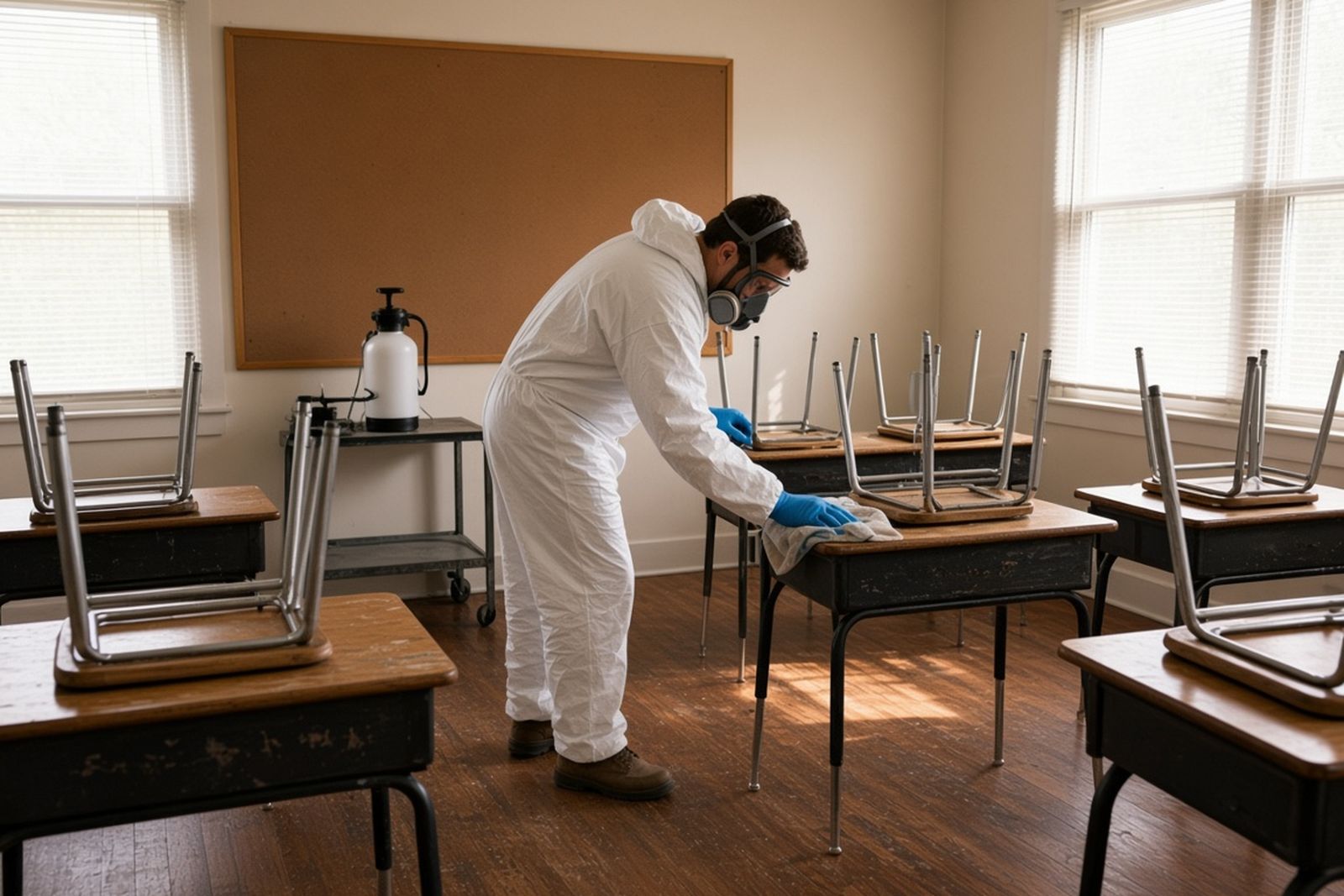
Question 3: What is the contact time on the label, and how will your crew keep surfaces wet that long? Contact time is how long the disinfectant must stay wet to work. You want a concrete answer. For example, the company might explain how they reapply on walls and other upright surfaces. They might explain the order they treat rooms so the product does not dry early, and how a supervisor checks.
Question 4: What cleaning happens before you disinfect? Dirt, body fluids, and residue can shield germs from the chemical. Many labels require cleaning heavily soiled surfaces first. A company that plans to spray without cleaning may leave you a building that smells like disinfectant. But the surfaces that matter may still be contaminated.
These two questions often show you who understands how disinfectants work. They also show you who leans mostly on equipment.
Questions 5 and 6: how are your workers trained and protected?
Question 5: What training have your workers had on the products and methods you will use in our building? Listen for training on reading labels, wet times, protective gear, and chemical safety. Ask whether the people coming to your site are employees or subcontractors. Ask who supervises them.
Question 6: Do you keep a bloodborne pathogens program if your work may involve blood or body fluids? This matters in clinics, group homes, gyms, and schools, where injuries happen. OSHA's Bloodborne Pathogens standard covers employers whose workers may be exposed. It requires them to keep a written exposure control plan, offer hepatitis B vaccination, and train those workers. A good company can tell you who keeps that plan up to date.
A company that can explain its program in plain words is more likely to protect both its workers and the people in your building.
Questions 7 and 8: delicate items and when people can return
Question 7: How will you handle electronics, upholstery, special equipment, and items children put in their mouths? Some products can damage screens or cloud plastics. Some leave a residue that is not right for toys or surfaces that touch food. The company should tell you which items they will wipe and which they will skip. They should also tell you which items your own staff should handle.
Question 8: What are the rules for coming back in and airing out the space with this product? You need to know when staff and others can return to each area. You also need to know if anyone with asthma or chemical sensitivities should wait longer. Ask for the safety data sheet so your own safety lead can review it.
Both answers affect your daily operations as much as your safety. Bring in whoever handles your schedule and whoever sends notices to staff and families.
Questions 9 and 10: paperwork and limits
Question 9: What will your final report include, and can we see a sample? A useful report lists every room and surface treated. It gives the product and registration number, the wet times, the methods, the workers' names, and the start and finish times. Do you answer to a board, a licensing agency, or a health department? Show them the sample before you sign.
Question 10: What will you not do, and what claims will you not make? This question often gets the most honest answer of the call. A company you can trust will say they cannot promise that no one gets sick again. They will say that disinfection treats surfaces at one point in time. They will say their work does not replace medical or public health advice. Be careful with anyone who promises lasting protection from a single treatment.
Do you run a licensed facility, such as a childcare center, clinic, or care home? Ask your licensing agency or county health department whether the work must meet specific cleaning or reporting rules. Then share that answer with every company that bids.
Putting the questions to work
In practice, the answers sort companies quickly. One may quote fast but be unable to name the product. Another may name a product, then admit that its label does not list your germ. The company worth hiring names a product with that germ on the label. They explain which surfaces, such as mats or upholstery, will be cleaned before disinfection. They describe how surfaces will stay wet for the full contact time. And they send a sample report.
Once the work is done, send a short notice to staff, members, or families. Tell them the space was professionally cleaned and disinfected. Add a practical reminder, such as wiping shared equipment before and after use. That way people know what part they play.
When you call companies in the middle of an outbreak, it is easy to remember the most confident voice. That is not always the most accurate answer. A simple comparison sheet keeps your decision grounded.
Make a grid with the ten questions down the side and each company across the top. For each answer, note whether it was specific and easy to check, vague, or missing. A product name with a registration number is specific. A promise that the product kills everything is vague. No answer at all is missing.
Then look at the pattern, not the price. Look for specific answers on the product, the wet time, the cleaning step, and the report. A company with those answers is usually a safer choice than a cheaper one with gaps. Those are the parts of the job you cannot easily check after the crew leaves.
If two companies look equally strong, practical things can break the tie. Who can come during the hours you are closed? Who has worked in buildings like yours? Whose report fits what your board or regulator expects? Share the grid with whoever approves the purchase, so they understand why you chose as you did.
What else should you check before you sign?
Beyond the ten questions, a few practical checks will round out your decision. None of them take long. Each one protects you from a common problem.
Keep copies of everything the company sends you. If questions come up months later, you will want the product label, the written work plan, and the report in one place.
- Proof of general liability insurance that names your organization, if your policies require it
- References from places like yours, such as schools, clinics, or fitness centers
- A written work plan that matches what you discussed on the phone
- A clear statement of the price, what it includes, and what would add charges
- The safety data sheet for every product the company plans to use
- The name and phone number of the supervisor who will be on site