Bethesda, MD

Infectious Disease Disinfection Planning in Bethesda, MD

What to do, who to contact, and what to ask in Bethesda.

Illness in your Bethesda condo, home or office? Learn what a real disinfection job covers, what to ask, and why hospital sterilization claims do not fit.

Get an email reply about infectious disease disinfection

Send a short message to the follow-up inbox. A coordinator can reply by email. This form does not send emergency help; call 911 first if anyone is in danger.

Tell us what you need help with. Share a short description; please leave out medical details, access codes, and other sensitive information.

A request does not confirm a booking. For immediate danger, contact local emergency services.

Or email info@facilitydisinfectionguide.com

The short answer for Bethesda, MD

Living in Bethesda, you are close to major medical campuses, and some cleaning companies borrow hospital words they should not. After an illness in your condo, house or office, what you need is ordinary cleaning followed by a labeled disinfectant. See how to judge a company, protect fragile family members and keep useful records.

What to do, step by step

  1. 1

    Say whether your space is a home, an office or a clinic

    Put the property type at the top of any written plan. Unless your space is a licensed clinical setting, the work is cleaning first and disinfecting second, as CDC's community guidance describes. Hospital sterilization guidance should come up only to explain what is not being claimed. If the job on Wisconsin Avenue may involve blood or other body fluids, ask the company how its workers are protected under OSHA's blood rules.

  2. 2

    Ask for elevators and stairs to be treated first

    In a tower, the shared path is where germs move. Ask that elevators, stair rails, trash rooms and amenity doors lead the list. Grime is cleaned off, then disinfectant is applied and left wet for a timed period. Floors should reopen in stages so you and your neighbors do not brush past wet panels. Fogging the lobby is no replacement for wiping elevator buttons, above all if the fog skips the wet time.

  3. 3

    Check the product claim and read the notice

    Find out which product is planned and whether its label lists the germ you are concerned about. List N can be cited for the COVID-19 virus, with no hint that it covers everything. If your HOA sends a notice, it should be short and factual. It can point residents to Montgomery County HHS or the Maryland Department of Health for community advice. It should not diagnose anyone or name a unit.

  4. 4

    Know what proof is realistic

    If you work in science, you may want to ask about sterility levels. Those belong to medical devices, not condo hallways. What you can fairly expect is a record built on the label, with timed wet-period logs. A swab of a hallway rail reads leftover organic film. It cannot find germs. Accept those records for what they are, and turn down any certificate that calls your tower sterile.

What cleanup is like in Bethesda

Bethesda sits beside large medical research campuses and clinics. That tempts some vendors to sell ordinary condo or office cleaning as hospital sterilization. You do not need that, and you should not pay for the label. CDC has one guideline for clinics and medical devices and a separate set of pages for homes and offices. An office on Wisconsin Circle or a high-rise near the Metro almost always belongs in the second group. The only exception is a space that is itself a regulated health care facility. Ask any company which CDC guidance its plan follows.

In the high-rises along Rockville Pike and Wisconsin Avenue, hundreds of hands meet on the same elevator buttons, package room doors, gym equipment and trash-room handles. If illness is spreading on your floor, the elevators and stairs you share with neighbors matter most. A fogged guest closet matters very little. Ask your manager what will be treated and in what order. For news about outbreaks, the Montgomery County Department of Health and Human Services is your local source. For statewide guidance, look to the Maryland Department of Health.

Many Bethesda households include someone with a weak immune system, or a clinical worker who changes clothes at the door. Surface disinfection can lower risk for your family. It does not replace your doctor's advice, vaccine choices or the infection rules at a workplace. The product still has to list your germ on its label and stay wet for the full time. EPA List N helps you choose a product for the virus that causes COVID-19. In a household that talks about many germs, it is not proof against all of them.

What to expect for your type of home

  • Condos and offices near the medical campuses: Tell the company in plain words that yours is a home or ordinary office. Ask it to write that on the plan, so hospital rules are not claimed.
  • High-rise common areas: Elevators, trash rooms, package rooms and the gym should be treated before decorative surfaces inside anyone's unit. Ask your board or manager for that order in writing.
  • Homes with a medically fragile resident: Talk through how long that person will stay out and whether strong smells could bother them. Ask for lower-odor products where the label allows.
  • Households with medical equipment: Cleaning of medical devices and instruments is not part of a home disinfection job. Follow the device maker or your care team for those, and keep them off the company's list.
  • Buildings with recirculating HVAC: Shared air handling can make chemical smells last on your floor. Ask how the system will be set during the work and how long airing out should take.
  • Buildings sending amenity notices: A notice about the gym or party room should never carry medical details from a unit. Ask to see the wording if the illness was in your home.

Papers and records to keep

  • The property type: an ordinary home or office, or a regulated health care space
  • The list of high-touch spots on elevators, amenities and the path to unit doors
  • A label sheet for each bottle used in the hallway, showing germs listed and wet time
  • The cleaning record and what was decided about soft items
  • Wet-time logs for the elevator and stair surfaces on your floor
  • The plan for when medically sensitive residents stay out
  • Written instructions on fresh air and when you may return
  • Copies of HOA or employer notices, with no personal health information

Local offices and official help

Common questions in Bethesda

Our condo wants to advertise hospital-grade sterilization of the hallways. Is that fair?

No. Hospital sterilization programs deal with medical devices and clinic rules, run by infection-prevention staff. Your hallways are community space. An EPA-registered disinfectant can lower germs on treated hard surfaces, if cleaning comes first and the contact time is met. That is still not sterilizing the building, the air or untreated apartments. Overclaiming confuses neighbors who work in medical research and gives false comfort. Ask that the newsletter describe elevator and amenity work in plain cleaning terms.
Illness is going around my floor. What should the building treat first?

The elevator panels and the door handles on your floor come first. Trash-room access, package lockers and the laundry or gym doors your neighbors use follow. Grime and film are cleaned off before disinfectant goes on and stays wet for the full time. Your own unit needs your permission and may be outside a building-only job. Fabric items in amenity rooms are washed or left out. Elevators reopen once the contact time ends, and no notice should name a household.

I have a weak immune system. What should I ask before my building is treated?

Ask which products will be used and request the safety data sheets. Get written word that you will be out during spraying and the wet time. Ask for the fresh-air steps and the reopening time on paper too. Find out whether soft items in your unit will be sprayed or removed. You can request fragrance-free or lower-odor products when the label allows. Surface cleaning is not a medical all-clear, so keep following your doctor's precautions.

Does List N cover all the germs my family worries about?

No. List N is built around the COVID-19 virus. For any other germ, the proof has to come from the product's own label. Spore-forming bacteria and some tougher viruses may call for a different product. A bottle you bought for COVID-19 is not an answer to every later worry. Cleaning still comes first, and even correct disinfecting does not sterilize soft items. Ask for records that state exactly what the label says, with the untreated floors and rooms listed.

When do OSHA's blood rules matter for cleaning at my office?

They matter when the job includes blood or body fluids that can carry disease. In that case the employer or contractor should follow OSHA's bloodborne pathogen rules, with protective gear and proper waste handling. Disinfecting after a cold or flu is a different, simpler task. If your office shares a building with a clinic, the clinic has its own procedures upstairs. For the lobby or your suite, tell the company what kind of mess is really there before they quote.

A family member is coming home from a hospital stay. How should we clean?

Follow the hospital's discharge instructions first. They may give cleaning or laundry steps for that person's condition. In the rest of your home, wash the bathroom and bedroom surfaces the person uses with detergent. Then disinfect handles, taps and bedside surfaces with a product labeled for the concern the care team named. Ask the doctor or home-health nurse before using strong products near someone recovering from lung or heart problems. Store medical supplies apart from cleaning supplies.

What can I expect from building management after an illness on my floor?

Expect a factual notice saying which common areas are closed and when they reopen. It should not say who was sick. Management may clean elevator buttons, trash-room doors and hallway handles more often for a while. You are free to ask which products they use. If you have asthma or chemical sensitivity, ask for the safety data sheet. Your own unit is your job unless your lease or bylaws say otherwise, so check before assuming staff will come in.

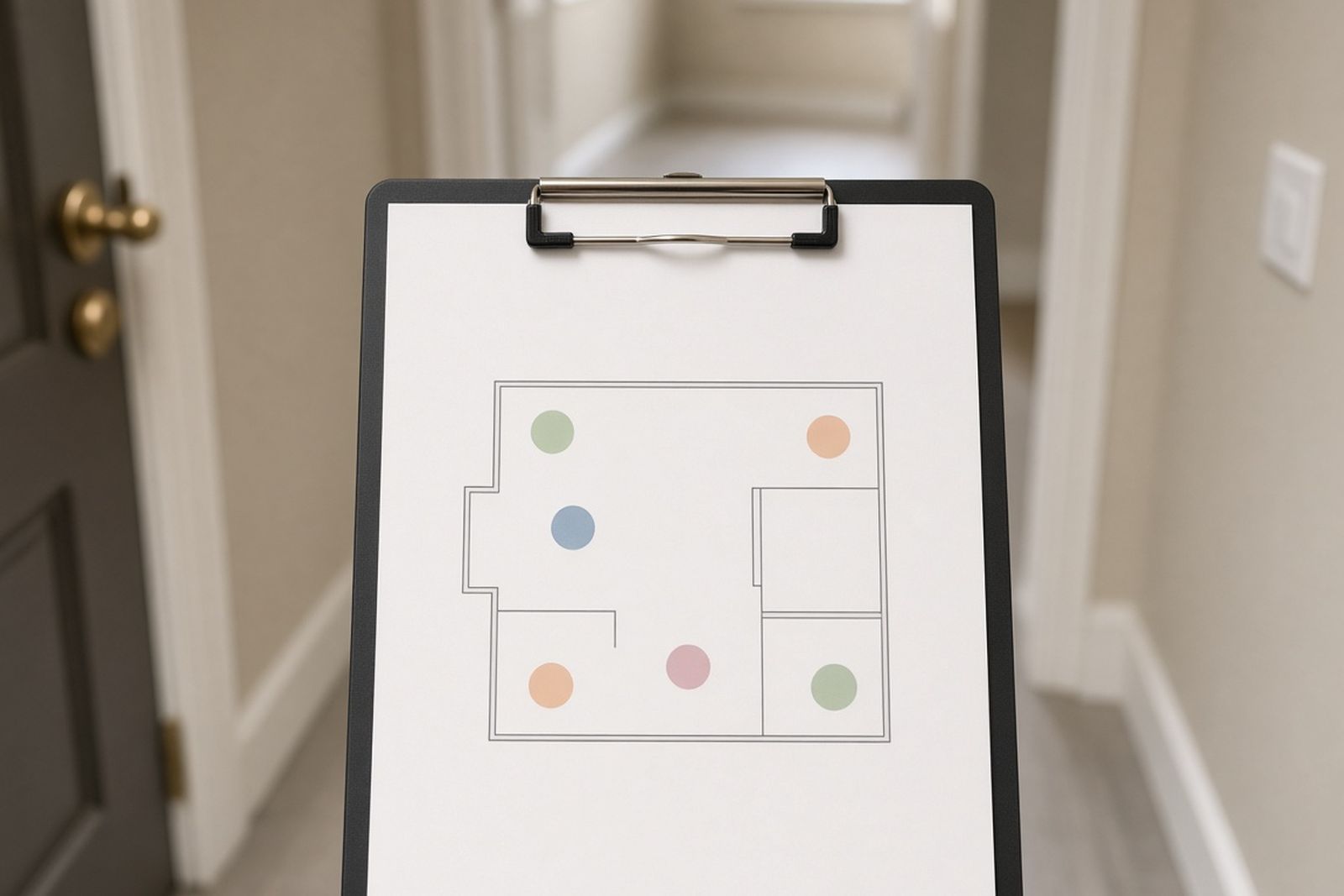
Clipboard showing a room plan with color-coded dots marking high-touch surfaces
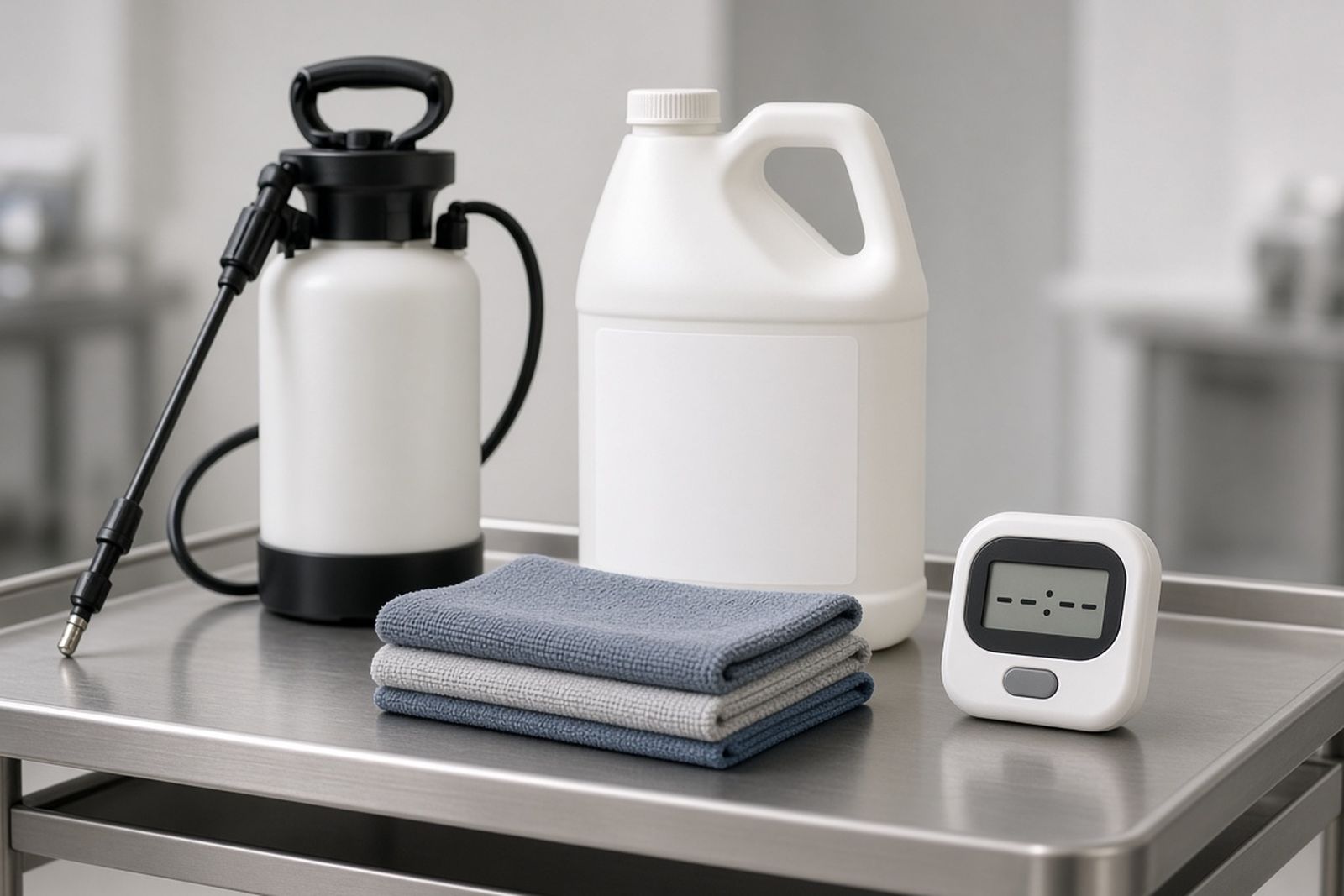
Pump sprayer, disinfectant jug, folded cloths and a contact-time timer on a steel cart

Facts worth knowing

  • In a March 2020 U.S. survey, 42% of people did not leave disinfectant sprays and wipes wet long enough to work, and 26% wiped right after spraying.

    Why it matters: Read the label for how long the surface must stay wet, and do not wipe your disinfectant off early.

    Source: American Cleaning Institute, 2020

  • In a 2019 survey of 47 US hospital cleaning departments, spore-killing products were common in contact-isolation rooms but uncommon in ordinary rooms.

    Why it matters: Not every disinfectant kills spores; if your germ forms spores, ask whether the product used is rated for them.

    Source: Han et al., 2021

  • In one field test published in 2023, wiping by hand passed the study's disinfection test on 98.1% of surfaces, compared with 75.5% for a UV-C light device.

    Why it matters: If a company offers you UV light treatment, ask whether surfaces are also cleaned and wiped by hand.

    Source: Knobling et al., 2023

Tools that help right now

What would you do?

Poll results

Vote to see how other people answered. You can change your answer at any time.

Your experience

When your facility had an illness cluster, how did you handle cleaning?

Be the first to vote
Process

How did you decide whether to close all or part of the facility?

Be the first to vote

Need help in Bethesda?

Send a short message about the property to the follow-up inbox. A coordinator can reply by email with next steps.

Your request is sent to the follow-up inbox. A coordinator can reply by email.

If anyone is hurt or in danger, call 911 first.