Short answer
Start by sorting what the job will produce: regulated waste, sharp objects, chemical waste and ordinary debris. Then find the state agency that oversees medical waste, since EPA's federal program ended in 1991. Check whether haulers must register, what packing and tracking records apply, and what your local landfill accepts. Last, ask each company to show how its disposal meets those rules.
Why is EPA not the main source for crime scene waste rules?
Many people start on EPA's website, expecting a national rulebook for biohazard waste. What they find is a short note that the federal role changed decades ago. According to EPA, the federal Medical Waste Tracking Act regulations expired on June 21, 1991. Since then, medical waste has been regulated mainly by state environmental and health departments.
EPA still matters in other ways. It registers the disinfectants crews use. It regulates hazardous chemical waste under federal law. But for blood-soiled carpet, couch fabric, drywall and sharp objects from a crime scene, your state is usually the main authority.
That shift is the key to looking up waste rules without wasting time. Once you know to look at the state level first, the rest of the process becomes much clearer.
It also helps to know that EPA pages on meth labs, mold or hazardous household waste are not written for blood-soiled materials. Those programs can give you useful background. But they will not tell you how to dispose of a stained sofa cushion after an assault.
The waste streams a crime scene produces
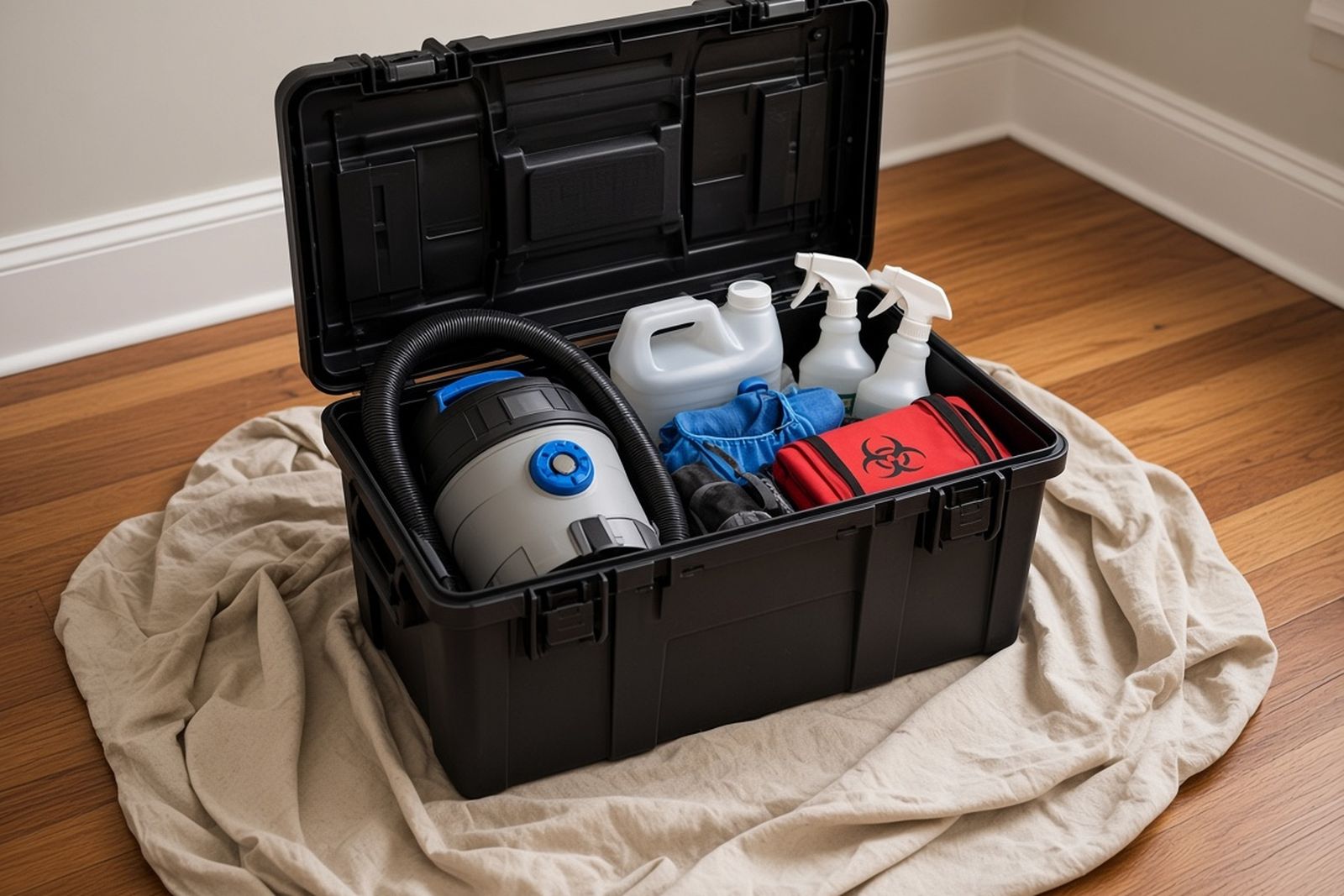
Before you look up rules, it helps to know what you are asking about. A typical crime scene job produces several kinds of waste. Each kind may fall under a different rule.
For the blood and body fluid portion, the usual starting point is the federal workplace definition of regulated waste. It includes items caked with dried blood and blood-soiled sharp objects, and it calls for special handling. Materials that are soaked or dripping with blood also fall into this group.
Sorting matters because each kind of waste can carry a different cost and go to a different place. A company that lumps everything into regulated waste may charge you more than needed. One that treats everything as ordinary trash may be breaking the rules. The goal is correct sorting based on what each item really is.
- Regulated waste: blood-soaked carpet, pad, cushions, bedding, drywall and used protective gear
- Sharp objects: broken glass, needles and jagged metal with blood on them
- Chemical waste: leftover disinfectants or cleaning products that cannot go down a drain
- Ordinary debris: clean materials removed to reach the affected areas
- Belongings that can be saved: items that can be cleaned and returned to you
Step 1: search your state agencies
Begin with your state environmental agency and state health department. One or both usually publish medical waste rules, guidance documents and lists of permitted treatment plants or registered haulers. States describe the same materials in different words. So search their websites with several terms: medical waste, regulated medical waste, biohazardous waste, infectious waste and trauma scene waste.
Look for answers to a few practical questions. How does the state define regulated waste for materials that come from outside a health care setting? Must a cleanup company register as a waste producer or hauler? What packing and labeling does the state require? Is a tracking document or waste shipping record needed when waste leaves your property? Which facilities may accept it?
Step 2: call, and write down what you learn
If the website is unclear, call the agency. Staff can often tell you in a few minutes which program covers crime scene waste and whether a cleanup company must be registered.
Write down what you learn. Include the name of the program, the date you checked and any staff member you spoke with. Rules and guidance documents are revised from time to time. A short note will help if you need to return to the question or compare what different companies tell you.
Which federal transport rules still apply?
States control treatment and disposal. The U.S. Department of Transportation, or DOT, governs how regulated medical waste moves on public roads. Its rules cover packing, labels, driver training and shipping papers.
Packing limits are one example of how specific these rules are. DOT's Pipeline and Hazardous Materials Safety Administration publishes them in 49 CFR 173.197. Under that DOT rule, plastic film bags of solid regulated medical waste are capped at 175 liters (46 gallons). Under the same DOT rule, bags placed in carts or bulk packagings are capped at 10 kg (22 lb) when filled.
You will rarely need to know details like this yourself. They are useful mainly as a signal. A company that hauls its own waste should know them. One that hires a licensed hauler should be able to name that hauler.
Step 3: check local rules
Local solid waste authorities decide what city and county landfills and transfer stations will accept. Many will not take untreated regulated waste at all. Some set rules for construction debris removed during cleanup.
Your county or city health department may also have guidance for biohazard cleanup. It may have rules for certain property types, such as restaurants, schools or rental housing. A quick call can show whether anything beyond state rules applies at your address.
If you live in a condo or a rental, check with the association or landlord as well. They may have rules about where bagged waste can be set and when it can be carried through common areas.
Some areas offer drop-off programs for household needles or medications. Those programs are generally meant for residents, not for waste from a professional cleanup. Ask before you assume a community program can accept crime scene materials.
The research in practice
The steps are easier to see in an example. Suppose a property manager oversees a small office building where an assault took place in a stairwell over a weekend. Police release the scene on Monday. Before hiring a cleanup company, she spends an hour looking up the waste rules so she can judge the bids.
She starts on EPA's medical waste page and learns that states now regulate this area. She moves to her state environmental agency's website. There she finds a regulated medical waste program and a public list of registered haulers. The program's definition includes blood-soaked materials from places other than health care settings.
Next, she calls the county solid waste office. It confirms that the local landfill does not accept untreated regulated waste but will accept clean construction debris. She also checks the building lease. Contractors must set waste in the loading area, not the lobby.
When she interviews companies, she asks each one to name its hauler and treatment plant. One company names a hauler on the state list and offers to send a copy of the tracking document afterward. Another says it takes waste to the local dump. She chooses the first. The building and manager are invented. The steps are what you can use.
Records to request after the job
Records are your best proof that the waste was handled properly. Ask for them in writing before the work begins, so there is no confusion later.
Keep these records with your other property files. They can be useful if an insurer, victim compensation program, landlord, buyer or government agency later asks how the cleanup was done.
If a company cannot supply disposal records, ask why. Some small jobs are combined with others before pickup, which can make the documents less specific. But the company should still be able to show you which hauler took the waste and where it went.
- A list or photo log of the materials removed
- The name of the hauler and, where it applies, its registration number
- A tracking document, waste shipping record or receipt showing where the waste was taken
- Confirmation of treatment or disposal from the facility that received it, if available
- A final report that sums up the cleanup
What questions reveal whether a company knows the rules?
Your research gives you the background to ask sharper questions. A company that knows the rules will answer in specifics and without hesitating. Vague replies, such as "we take care of it," deserve a follow-up question.
Rules vary by state and county, so check each answer against what your state agency and county solid waste office told you. Good companies welcome informed customers. It makes their careful work easier to see.
- Which state agency regulates the waste from this job?
- Are you registered as a waste producer or hauler, if the state requires it?
- Who hauls the waste, and to which facility?
- How will sharp objects and chemical waste be handled separately?
- Which items do you expect to throw away, and which can be cleaned and returned?
- What disposal records will I get, and when?
Why proper disposal matters
Crime scene waste that is thrown away improperly can expose sanitation workers, neighbors and the public to blood and sharp objects. It can also create legal problems for the company. In some cases, it raises questions for you as the property owner who hired it.
A little research and a few direct questions help make sure soiled materials leave your property safely and end up where they belong. That final step is as much a part of restoring your space as the cleaning itself.
If you ever suspect that waste from your property was dumped improperly, contact your state environmental agency. Reports like these help regulators find problem operators. They protect the next family or business that needs help.